Advice & guides · 4 min read
Boosting maths engagement through primary school students’ real interests: turning groans into grins
-
Boosting maths engagement through primary school students’ real interests: turning groans into grins
3-4 minute read
-
How many times have you announced, “Today we’re doing some maths word problems!” only to be met with a collective groan from your class? For many primary teachers, this scene is all too familiar. But the problem usually isn’t the maths itself. It’s the context.
Traditional maths problems often feel disconnected from students’ everyday lives. A question about apples, marbles, or trains might be mathematically sound, but if it doesn’t connect to what your learners actually care about, it can fall flat. The good news? With a little creative thinking, you can transform those groans into genuine grins – and boost learning outcomes along the way.
Why interest-based maths problems matter
Students are naturally motivated by what they enjoy. Whether it’s a favourite video game, a beloved pet, a sports team, or the latest movie, children engage deeply when content reflects their real-world interests. When maths word problems draw from those interests, something shifts: the lesson becomes personally relevant.
A quick example
Instead of saying, “There are 15 marbles in a jar, and 7 are red. What fraction are red?”
Try: “In Among Us, there are 15 players in a game, and 7 are impostors. What fraction are impostors?”
The mathematical skill is identical – calculating a fraction – but the impact on engagement is completely different. The second question feels alive, modern, and connected to students’ cultural world. You’ll likely see smiles, laughter, and maybe even a debate about how Among Us actually works – but most importantly, you’ll see engagement.
The research behind engagement and context
Research consistently shows that interest is a powerful driver of learning. According to Jo Boaler (2016), contextualised and creative maths tasks help students experience mathematics as flexible, meaningful, and connected to the real world. When learners are emotionally engaged, they’re more willing to take risks, persist through challenges, and develop a positive mathematical mindset.
Enjoyable, low-threat problem contexts can significantly reduce maths anxiety by helping students feel capable and connected before tackling more complex tasks. This is especially important in the primary years, when attitudes toward maths begin to solidify
In contrast, decontextualised or overly abstract problems can alienate students – particularly those who already feel anxious about maths. Boaler (2016) notes that enjoyable, low-threat problem contexts can significantly reduce maths anxiety by helping students feel capable and connected before tackling more complex tasks. This is especially important in the primary years, when attitudes toward maths begin to solidify.
Similarly, Deci and Ryan’s (2017) self-determination theory supports the idea that autonomy and relevance are essential to motivation. When students recognise their own interests in classroom materials, they experience greater ownership of learning, which in turn promotes intrinsic motivation and deeper understanding.
The emotional payoff: from “I can’t” to “I get it”
When students see their passions reflected in learning, they feel valued – and that feeling matters. A student who usually shies away from maths might light up when a question involves their favourite sport or character. These moments build confidence, shift attitudes, and gradually transform self-perceptions from “I’m not good at maths” to “Maths can actually be fun.”
This change isn’t superficial. As Boaler (2016) explains, mindset and emotion are intertwined with cognition: students who feel positive about maths are more likely to engage deeply and persist through challenges. When teachers connect learning to real interests, they’re not only improving participation but also nurturing long-term mathematical resilience.
Final thoughts
Bringing students’ interests into maths word problems isn’t a gimmick – it’s a research-informed, equity-focused practice that helps all learners see themselves as capable mathematicians. By anchoring lessons in what students already love, you’re not diluting the rigour of maths; you’re deepening its relevance and accessibility.
So next time you sense that collective groan coming, try swapping apples for Among Us or blocks for Minecraft. You might just find that your students aren’t dreading word problems – they’re ready to dive in.
-
Special offer:
Order Matharoo now for Terms 2-4 and get the rest of Term 1 free!End Term 1 on a high note for your students.
Order now and receive your first worded problem sheets within minutes!
Classroom tip
You may love the idea of boosting your students’ maths engagement by including your students’ interests in worded maths questions, but your already heavy load as a teacher makes it hard. You need to find the time, the focus and the headspace to prepare them. And that’s where Matharoo can help.
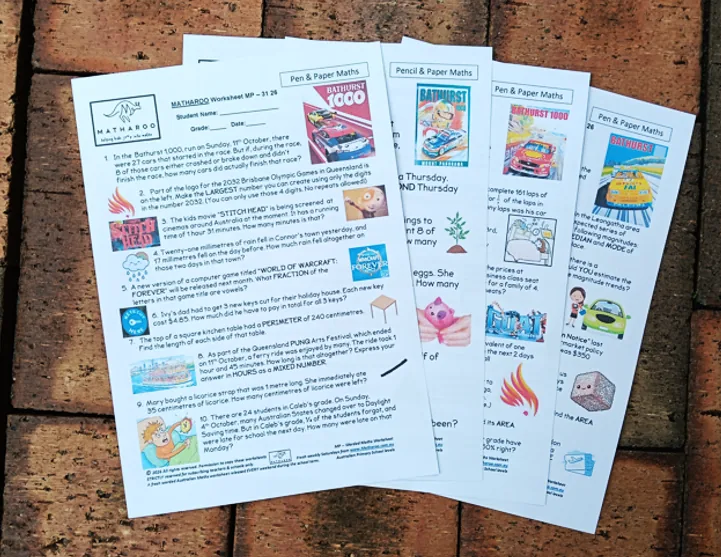
Matharoo produces fresh-weekly worded problem sheets for primary school-aged learners featuring questions drawn from last week’s current events, pop culture and sports news stories. They’re written specifically to be of interest to primary school-aged kids, ready-to-go. And written by qualified educators, Matharoo is curriculum-aligned so will be the perfect supplement to your existing lesson plan.
Kids love Matharoo, teachers say it’s a weekly delight, and parents say they notice the difference in their kids’ attitudes to maths. Matharoo brings real-world relevance to maths, making it meaningful and fun for young learners.
Watch as maths comes alive for your students. Join the Matharoo crew.
-
References
Boaler, J. (2016). Mathematical mindsets: Unleashing students’ potential through creative math, inspiring messages and innovative teaching. Jossey-Bass.
Deci, E. L., & Ryan, R. M. (2017). Self-determination theory: Basic psychological needs in motivation, development, and wellness. Guilford Publications.
Free sample
See a real week first
All four levels and the answers, in one PDF. It downloads straight away.