Advice & guides · 3 min read
Building student agency in worded maths problem solving: primary school classroom strategies that work
-
Building student agency in worded maths problem solving: primary school classroom strategies that work
3-4 minute read
-
Student agency – where learners exercise initiative, make choices, and reflect on their strategies – is a powerful lever for deeper mathematical learning. Agency transforms maths from following procedures to being an active, creative endeavour.
Practical classroom strategies
- Design tasks with multiple entry points. Open-ended problems allow students to choose starting strategies and representations. For example, “How many different arrays make 12?” invites diverse approaches.
- Teach strategy repertoire. Intentionally teach several methods (e.g., partitioning, number lines, visuals) so students have authentic choices.
- Foster reflection and metacognition. Regularly ask students to explain why they chose a strategy and how they checked their work. Use sentence stems: “I tried…, because…, Next time I would…”
- Encourage student-led problem posing. When students create their own problems, they practice anticipating reasoning demands and evaluating solution methods.
- Use collaborative routines. Structured talk protocols (e.g., “Compare & Connect”) let students share strategies and critique reasoning in a safe environment.
What the research tells us
Munson (2020) discusses maths agency as being about a student’s willingness and ability to act with intentionality and power to shape their learning trajectory. When students take the initiative to question, challenge, or offer their own mathematical ideas, they are asserting their identity as thinkers.
Kapur’s research on productive failure shows that when students generate and test their own ideas before instruction, they often develop superior conceptual understanding – provided teachers follow up with consolidation and formalisation.
Classroom culture and assessment
Agency depends on a classroom culture that values multiple methods and sees errors as learning opportunities. Assessments should capture reasoning and strategy choice, not only final answers. Portfolios of student work and short strategy interviews can document growth in agency and reasoning.
The theory in practice
- Begin with strategy lessons and explicit choice-making.
- Introduce open-ended tasks weekly.
- Schedule reflection sessions and student-led problem presentations.
- Use formative assessments to capture strategy use.
References
Munson, J. (2021). Negotiating identity and agency amidst pedagogical change: The case of student push back. Journal of the Learning Sciences, 30(4–5), 646–675. doi.org/10.1080/10508406.2021.1954522
Leijen, Ä., Baucal, A., Pikk, K. et al. Opportunities to develop student’s math-related agency in primary education: the role of teacher beliefs. Eur J Psychol Educ 39, 1637–1659 (2024). doi.org/10.1007/s10212-023-00771-9
Kapur, M. (2018). Productive failure in learning math. Cognitive Science, 42(4), 974–1003. doi.org/10.1111/cogs.12107
-
Classroom tip
You may love the idea of including your students’ interests in worded maths questions each week, but your already heavy load as a teacher makes it hard. You need to find the time, the focus and the headspace to prepare them. And that’s where Matharoo can help.
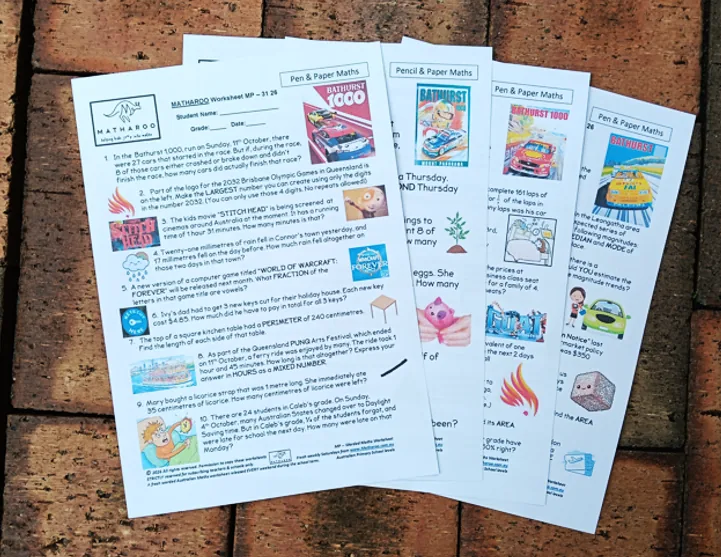
Matharoo produces fresh-weekly worded problem sheets for primary school-aged learners featuring questions drawn from last week’s current events, pop culture and sports news stories. They’re written specifically to be of interest to primary school-aged kids, ready-to-go. And written by qualified educators, Matharoo is curriculum-aligned so will be the perfect supplement to your existing lesson plan.
Kids love Matharoo, teachers say it’s a weekly delight, and parents say they notice the difference in their kids’ attitudes to maths. Matharoo brings real-world relevance to maths, making it meaningful and fun for young learners.
Watch as maths comes alive for your students. Join the Matharoo crew.
Free sample
See a real week first
All four levels and the answers, in one PDF. It downloads straight away.