Advice & guides · 5 min read
Maths, language, literacy, and fostering a lifelong love of learning: the role of primary school student interests
-
Maths, language, literacy, and fostering a lifelong love of learning: the role of primary school student interests
3-4 minute read
-
In every primary school classroom, there are students who shine in verbal tasks but stumble over maths word problems. There will be others who grasp number concepts easily but struggle when the maths is wrapped in text.
Why is this?
Because solving word problems isn’t just about numbers. It’s also about language, literacy, and comprehension.
For many students, the challenge lies not in the maths itself, but in the words. The ability to unpack a problem, interpret the question, and translate it into a mathematical process all rely on strong reading skills. But here’s the hopeful part: when the context of a maths problem aligns with students’ interests, the literacy barrier becomes easier to cross.
When familiar language lightens the load
Imagine a student who struggles with reading but adores animals. A problem that reads, “A zookeeper needs to feed 4 elephants. Each elephant eats 3 bales of hay a day. How many bales does the zookeeper need?” is far more inviting than one about arranging chairs in a hall.
The student’s familiarity with the topic – elephants, food, zoos – activates background knowledge and makes the problem’s vocabulary more accessible.
When learners are engaged by the content, they’re more motivated to persist, better able to infer meaning from context, and more confident in their reasoning. That’s why embedding student interests – from animals and sport to gaming and art – can have such a transformative impact on their experience of maths.
The research behind the link
A growing body of evidence supports the critical connection between language comprehension and maths success. Fuchs et al. (2018) found that text comprehension and oral language are powerful predictors of students’ ability to solve maths word problems. Their study highlights that word problems function as a form of text comprehension – meaning that students who struggle with reading will likely struggle with maths word problems too.
However, when teachers use language and contexts that are familiar and meaningful, they reduce this cognitive load. Students no longer need to devote so much effort to decoding the vocabulary, freeing up mental resources for the actual maths reasoning.
Similarly, Vilenius-Tuohimaa et al. (2022) found that integrating literacy and numeracy instruction – especially through contextualised problem-solving – enhances both reading comprehension and mathematical reasoning. When teachers explicitly link language and maths, students begin to see patterns in how problems are structured, strengthening their confidence and understanding in both domains.
Practical classroom applications
Bringing student interests into maths word problems doesn’t mean sacrificing rigour. Instead, it means creating learning opportunities that are both accessible and challenging. Here are a few practical ways to put this idea into action:
- Use visuals alongside text. For students with developing literacy skills, pair word problems with simple images or diagrams. This helps them connect language with quantity and structure, supporting both comprehension and problem-solving.
- Explicitly teach maths vocabulary. Even familiar contexts can contain unfamiliar mathematical terms like perimeter, sum, or difference. Take time to unpack these words together. Encourage students to paraphrase problems in their own words before solving.
- Collaborate across subjects. Work with your school’s literacy coordinator or English team to align strategies for comprehension and problem-solving. Many reading strategies – such as predicting, questioning, and summarising – can be applied directly to maths texts.
Why it matters
For students who find maths intimidating, word problems can feel like a double hurdle: they require both numerical reasoning and reading comprehension. By grounding problems in topics students already know and love, teachers make that first hurdle smaller. The familiar vocabulary reduces anxiety, builds confidence, and helps students engage meaningfully with the maths beneath the words.
As Fuchs et al. (2018) remind us, word-problem solving is a form of reading comprehension. So, when we make the reading part easier and more engaging, we unlock access to the mathematical reasoning that follows.
Final thoughts
Maths and literacy are often treated as separate worlds – but in reality, they’re deeply intertwined. The words we choose, the contexts we set, and the interests we tap into all shape how students experience maths. When we invite learners into the world of word problems through language they understand and topics they care about, we’re not just supporting maths learning – we’re nurturing a lifelong love of learning itself.
-
Special offer:
Order Matharoo now for Terms 2-4 and get the rest of Term 1 free!End Term 1 on a high note for your students.
Order now and receive your first worded problem sheets within minutes!
Classroom tip
You may love the idea of fostering your students’ lifelong love of learning by including their interests in worded maths questions each week. But your already heavy load as a teacher makes it hard. You need to find the time, the focus and the headspace to prepare them. And that’s where Matharoo can help.
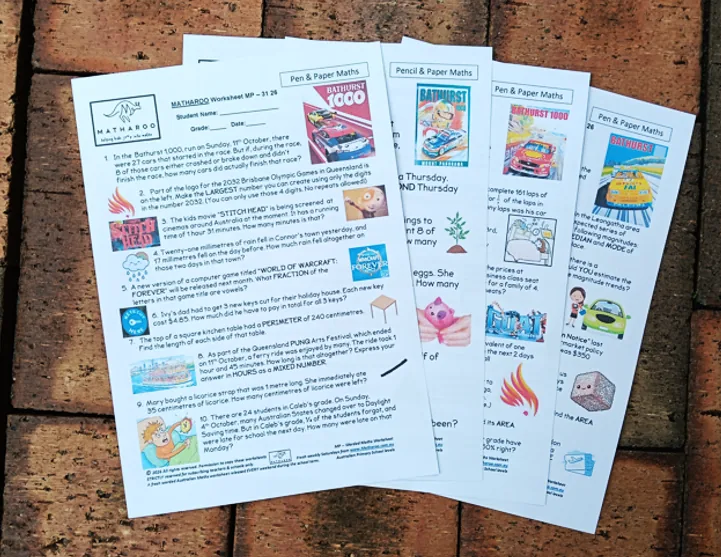
Matharoo produces fresh-weekly worded problem sheets for primary school-aged learners featuring questions drawn from last week’s current events, pop culture and sports news stories. They’re written specifically to be of interest to primary school-aged kids, ready-to-go. And written by qualified educators, Matharoo is curriculum-aligned so will be the perfect supplement to your existing lesson plan.
Kids love Matharoo, teachers say it’s a weekly delight, and parents say they notice the difference in their kids’ attitudes to maths. Matharoo brings real-world relevance to maths, making it meaningful and fun for young learners.
Watch as maths comes alive for your students. Join the Matharoo crew.
-
References
Fuchs, L. S., Gilbert, J. K., Fuchs, D., Seethaler, P. M., & Martin, B. N. (2018). Text comprehension and oral language as predictors of word-problem solving: Insights into word-problem solving as a form of text comprehension. Scientific Studies of Reading, 22(2), 152–166. doi.org/10.1080/10888438.2017.1398259
Vilenius-Tuohimaa, P. M., Aunola, K., Poskiparta, E., & Nurmi, J.-E. (2008). The interplay between reading comprehension and mathematical word problem solving during primary school years. Educational Psychology, 42(5), 578–596. DOI:10.1080/01443410701708228
Free sample
See a real week first
All four levels and the answers, in one PDF. It downloads straight away.