Advice & guides · 3 min read
The value of a weekly intentional lesson in maths worded problem solving in primary school classrooms
-
The value of a weekly intentional lesson in maths worded problem solving in primary school classrooms
3-4 minute read
-
As a classroom teacher, you know that integrating problem solving into daily or weekly practice is ideal. But there’s particular value in reserving a once-weekly dedicated lesson for worded problems: it lets you plan, model, scaffold, reflect, and track growth in ways daily quick problems sometimes cannot.
What makes a weekly intentional lesson different?
In a once-a-week lesson dedicated to worded maths problem solving, you can:
- introduce a particular problem type or strategy (e.g., compare, change, combine, ratio problems)
- model reading, interpreting, selecting operations, and checking
- provide guided practice with scaffolds (worked examples, shared thinking)
- allow independent practice within a safe environment
- lead class or peer reflection on methods and problem-solving strategies.
This kind of structure spreads out over time, allowing spaced practice that helps retention and transfer.
What the research tells us
- The Vessonen et al. (2025) meta-analysis of 115 reports with over 20,000 primary school students found strong positive average effects for interventions that are frequent, well implemented, and with fidelity in instruction. Weekly or similarly spaced lessons help maintain momentum and allow for scaffolding and feedback.
- Peng et al. (2025) found that combining strategy instruction and guided practice was among the most effective approaches, especially for pupils with identified difficulties in word problems. Regular lesson interventions are part of that kind of effective design.
Practical implementation ideas
The theory is one thing… but what about putting it to practical use? Here are a few ideas:
- Schedule and protect the time – ensure the weekly lesson isn’t overtaken by other demands.
- Plan around schema/problem type rotation – over weeks rotate through different problem structures, so students build breadth.
- Use worked examples & guided group work in early weeks of each type, then fade support.
- Provide rich feedback and reflection: show alternative strategies, common misunderstandings.
- Use regular formative assessment: track how students’ problem-solving strategies are developing and adjust your instruction accordingly.
Benefits you should expect
With a weekly intentional lesson on worded maths problem solving, you’ll likely see:
- deeper strategy use (students choosing methods, reflecting)
- improved accuracy and fewer misinterpretations
- improved resilience – students willing to tackle non-routine problems
- greater transfer: students apply what they’ve learned in new contexts
- better discussion among students about strategies and reasoning.
Challenges and how to mitigate them
- Curricular pressures can squeeze time. But consider this lesson as part of the core, not optional, and you’ll be rewarded in the results you’ll see.
- Teacher workload for planning specialised lessons. High quality prepared resources are available. Make use of them!
- Student variability can be managed by scaffolding for students who need more support, and giving extensions for the students who move more quickly.
Final thoughts for teachers
An intentional weekly lesson in worded problem solving isn’t just helpful – it’s transformational. It gives structure for modelling, scaffolding, strategy work, and reflection that daily quick tasks don’t always allow. Over time, these lessons build students who are stronger in understanding, selecting strategies, persisting, and reflecting. They’re worth protecting and planning well.
References
Peng, P., Liu, Y., Li, S., Namkung, J., Chow, J., & Lin, L. (2025). Exploring the effectiveness of word-problem strategy and strategy combinations: A systematic review and network meta-analysis. Educational Psychology Review, 37, Article 81. doi.org/10.1007/s10648-025-10057-9
Vessonen, T., Hellstrand, H., Kurkela, M., Aunio, P., & Laine, A. (2025). The effectiveness of mathematical word problem-solving interventions among elementary schoolers: A systematic review and meta-analysis. Educational Psychology Review, 37, Article 95. doi.org/10.1016/j.ijer.2025.102642
-
Classroom tip
You may love the idea of including your students’ interests in worded maths questions each week, but your already heavy load as a teacher makes it hard. You need to find the time, the focus and the headspace to prepare them. And that’s where Matharoo can help.
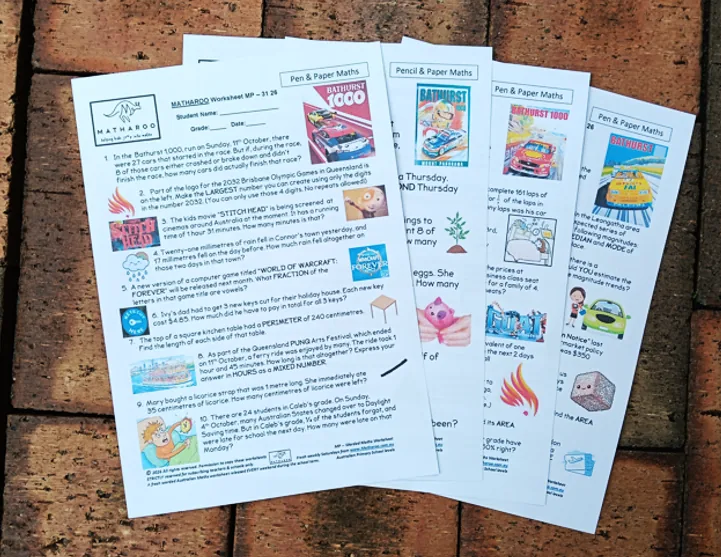
Matharoo produces fresh-weekly worded problem sheets for primary school-aged learners featuring questions drawn from last week’s current events, pop culture and sports news stories. They’re written specifically to be of interest to primary school-aged kids, ready-to-go. And written by qualified educators, Matharoo is curriculum-aligned so will be the perfect supplement to your existing lesson plan.
Kids love Matharoo, teachers say it’s a weekly delight, and parents say they notice the difference in their kids’ attitudes to maths. Matharoo brings real-world relevance to maths, making it meaningful and fun for young learners.
Watch as maths comes alive for your students. Join the Matharoo crew.
Free sample
See a real week first
All four levels and the answers, in one PDF. It downloads straight away.